
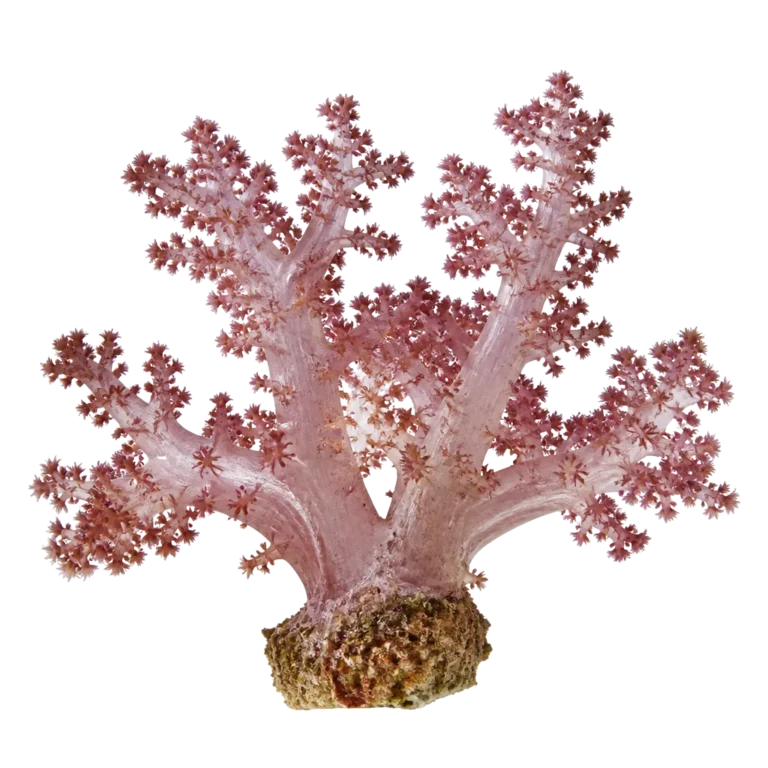
Thistle Coral
Summary
Thistle Coral is a trade name for Chironephthya sp., a genus-level identification rather than one reliably defined species. These are non-photosynthetic, branching soft corals with very small feeding polyps, so their survival depends on a constant delivery of suspended food rather than reef lighting. Their difficult reputation comes from balancing frequent planktonic feeding with the filtration needed to keep the system from becoming polluted.
Expect the colony to inflate and display a fine, fuzzy covering of polyps when conditions support feeding, then contract substantially at other times. A repeatedly shrunken colony, thinning branches, or tissue loss is a husbandry warning, not a normal substitute for acclimation.
General care
Place Chironephthya low in the aquascape where it receives broad, moving water and can be reached easily for observation and feeding. Secure the base firmly to a removable rock or plug; a colony that falls into sand can become coated in debris and may be difficult to recover.
Handle only by the hard attachment point or supporting rock. Do not squeeze, pull, or glue over the soft branches, because the tissue is easily bruised and damaged areas can deteriorate quickly. Buy a specimen only if it is intact at the base and shows at least some healthy polyp extension in suitable current.
Lighting needs
Lighting is not a food source for Chironephthya. Put it in shade or subdued light to limit nuisance algae on its tissue, but prioritize accessible placement and correct flow over darkness alone. There is no useful “too little light” response to watch for; poor extension in a dark location is more likely a feeding, flow, or general-health problem.
Do not try to correct a contracted colony by increasing light. If bright exposure repeatedly encourages algae or cyanobacteria to collect on the branches, relocate it to a dimmer area with enough water movement to keep the tissue clean.
Flow needs
Provide medium-to-high, turbulent flow that carries fine food through the entire branching structure without pinning it in one direction. At the right flow, the branches sway freely and the tiny polyps remain extended long enough to intercept suspended particles.
Too little flow leaves detritus on the colony, produces limp or poorly extended branches, and allows food to settle before it can be captured. Excessively direct flow keeps branches bent over, causes persistent polyp retraction, or abrades tissue where the colony rubs rock; redirect the pump or diffuse the stream rather than simply reducing overall circulation.
Feeding and growth
Feeding is essential rather than optional. Offer frequent small additions of fine suspended zooplankton-sized foods, including rotifers, copepods, and enriched marine plankton, while circulation distributes the food through the polyps. Large meaty chunks are a poor match for its tiny polyps and mainly create waste.
A colony that is consistently fed in suitable flow should hold fuller branches and show regular fine-polyp extension. Chironephthya generally develops as a slow-growing, upright branching soft coral, so leave room above and around it for expanded branches and for food-bearing water to pass through rather than crowding it into a crevice.
Compatibility
Chironephthya is generally peaceful and does not need space because of conspicuous sweeper tentacles, but its delicate branches still need a practical buffer of at least 10 cm3.9 in from neighboring corals. That clearance prevents contact, shading by larger colonies, and interrupted flow as the branches expand and sway.
Avoid fish and invertebrates that repeatedly pick at soft-coral tissue or steal the fine foods intended for the colony. Watch feeding sessions: fish, shrimp, and crabs that crowd the coral can prevent food capture, while persistent picking causes prolonged closure and can injure the branch tips.
Water parameters
This is more demanding than a typical reef coral because it needs frequent food input while remaining intolerant of the accumulating waste that heavy feeding can create. Stock it only in a system with enough mature biological and mechanical filtration to process that routine, and adjust feeding or export promptly if detritus, algae, or rising nutrient problems appear.
Keep salinity and overall chemistry notably consistent during water changes and dosing changes. Sudden shifts can coincide with prolonged contraction, but do not treat retraction as a water-test result by itself: first inspect the colony for settled debris, excessive current, food deprivation, or tissue damage at the base.