
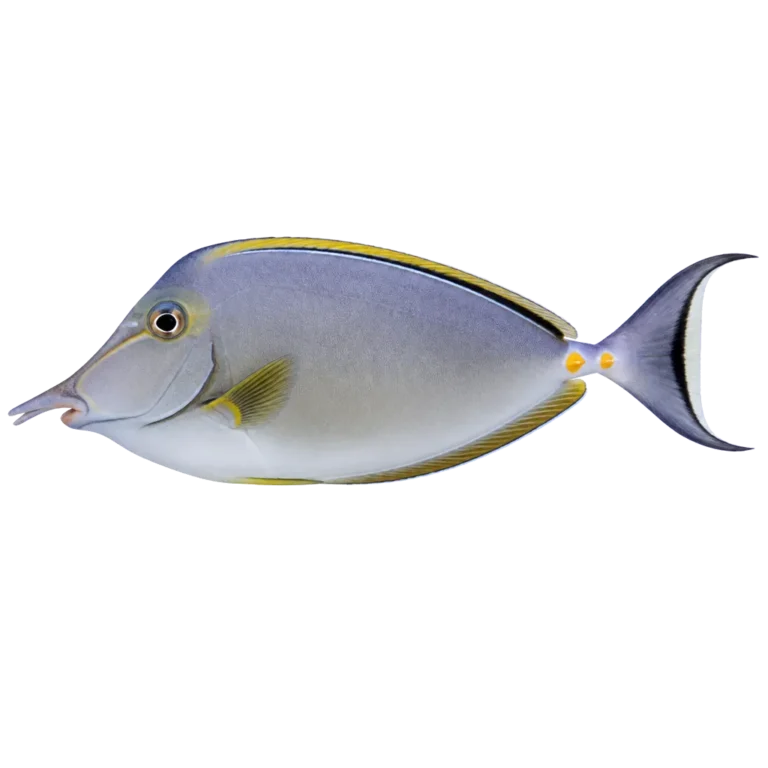
Vlaming’s Unicornfish
Summary
Naso vlamingii is an open-water cruiser rather than a rock-grazing fish that stays close to the aquascape. In nature, adults gather in the water column around reef drop-offs to take plankton, which translates to a fish that should spend much of the day making long, purposeful laps through open water.
Its generally peaceful manner can be misleading: its eventual bulk, speed, and constant movement make long-term space and filtration capacity more important than its temperament. Treat a juvenile purchase as a commitment to housing a very large, high-waste adult rather than as a fish for a tank it currently fits.
Care
Build the aquascape around uninterrupted swimming lanes. Keep the central and upper water column open, place rockwork securely at the sides or in low islands, and leave broad turning room; a fish that repeatedly brakes, paces along glass, or scrapes past structures needs a less obstructed layout.
Provide a few substantial retreats or shaded breaks, but do not fill the aquarium with caves. Naso vlamingii uses shelter when unsettled yet normally remains visible and active; persistent hiding, darkened coloration, or refusal to enter open water warrants checking for intimidation, disease, or inadequate acclimation.
Use vigorous circulation and strong gas exchange without aiming a harsh, narrow jet directly at its preferred route. This species is built for active midwater swimming and produces a heavy waste load, so declining oxygen or accumulating nutrients can show first as rapid breathing, reduced appetite, or unusual lethargy. Secure all rock and coral structures against the force of a fast, large fish turning nearby.
Feeding
Offer marine macroalgae every day, ideally in more than one small opportunity, while also feeding quality herbivore preparations and varied planktonic or marine meaty foods. This matches the mixed diet of Naso vlamingii better than treating it as either a strictly herbivorous tang or a fish that can live on occasional frozen food.
Feed smaller portions across the day when possible. Use an algae clip in an open, easy-to-reach area and distribute frozen or pellet foods broadly so faster tangs and large angelfish cannot monopolize the meal. A fish that waits at the surface but loses body depth behind the head or develops a pinched belly is not getting enough food, even if it appears eager at feeding time.
Plan food input and nutrient export together. Restricting food to keep nutrients low is a poor tradeoff for this active, high-demand species; instead, increase export capacity and remove uneaten food promptly. A diet dominated by rich meaty items while algae is ignored can contribute to poor condition and leaves its normal grazing behavior unmet.
Compatibility
Keep one Naso vlamingii per aquarium in most home systems. It may tolerate unrelated peaceful fish well, but another Naso or similarly shaped, active tang can become a territorial target once routes and feeding stations are established. Chasing, flank displays, or repeated tail-swiping are reasons to separate fish rather than waiting for the hierarchy to settle.
Favor robust, peaceful-to-confident fish that will not harass it during introduction and that can cope with its size and activity. Avoid cramped mixes of large tangs, highly territorial surgeonfish, or fish that defend the same open-water lanes and algae clips.
Add Naso vlamingii before more assertive tangs when the stocking plan permits, or introduce it with other tangs using temporary visual separation and multiple feeding points. Introducing it last to an established tang territory increases the chance that it will be pinned into a corner or denied food.
It is reef compatible in the sense that it normally leaves corals and sessile invertebrates alone. The practical exception is physical rather than dietary: an adult can topple poorly secured colonies or disturb loose frags simply by passing close to them.
Good to know
Use a fully secured cover or canopy. Startled Naso vlamingii can launch from open aquariums, and its size means an escape attempt can injure the fish and damage lightweight lids. Investigate sudden dashing or repeated attempts to swim upward as signs of harassment, reflections, or a disturbance outside the tank.
Expect appearance and behavior to change markedly as it grows. Juveniles do not show the full adult profile, and mature fish can develop a pronounced forehead and taller fins; blue markings may also intensify or fade quickly during displays. These changes are usually normal, whereas persistent dark stress coloration combined with hiding, rapid respiration, or appetite loss is not.
Handle only when necessary and use a rigid container rather than a net for transfer. Like other surgeonfishes, it has sharp tail-base spines that can catch in mesh and injure both the fish and the keeper.