
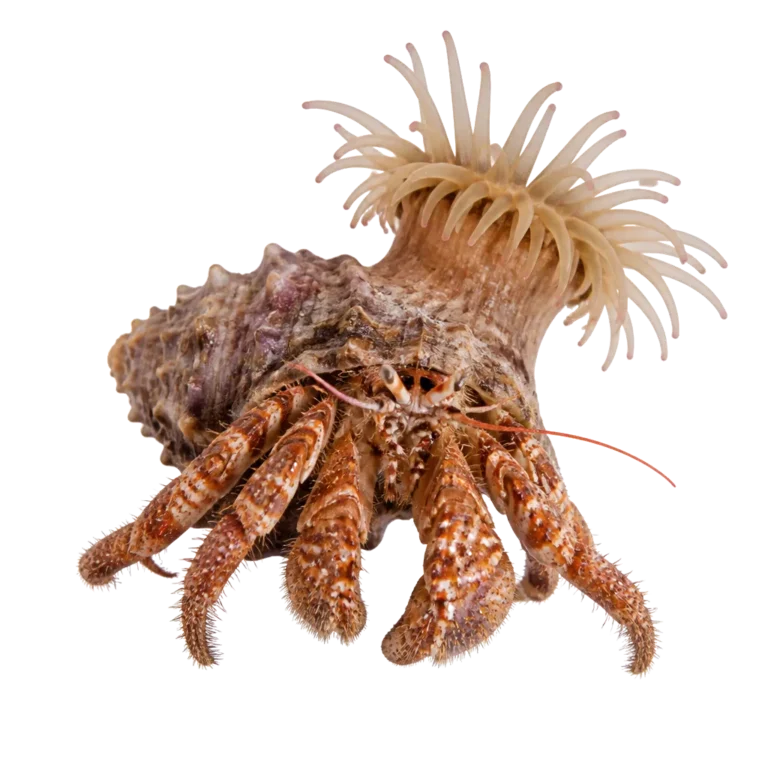
Anemone Hermit Crab
Summary
Dardanus pedunculatus is a large, mobile Indo-Pacific hermit crab that usually carries small sea anemones on its borrowed snail shell. Those anemones provide defensive stings, but in an aquarium they also make the crab a moving stinging hazard around corals and other sessile invertebrates.
Treat it as a predatory scavenger rather than a conventional small cleanup-crew hermit. Its size, strong claws, and need to change shells make it better suited to a spacious system with secure aquascaping than to a densely packed nano reef.
Care
Provide open sand or rubble-bottom routes between stable rockwork so the crab can forage and manoeuvre its shell without constantly dislodging livestock. Secure corals and loose frags firmly; a climbing crab carrying a bulky shell can topple unsecured pieces.
Keep several clean, empty marine snail shells available in a range of suitable openings. Shell competition is a common reason hermits attack snails or other hermits, and a crab repeatedly investigating occupied shells may be short of an acceptable upgrade.
A mature aquarium is useful because it supplies incidental detritus and natural grazing, but do not rely on this alone. The crab should still be deliberately fed, especially in very clean reef systems. Lighting is not important to the crab itself, and ordinary reef flow is suitable provided there are calmer routes along the substrate where it can feed and rest.
Feeding and role
Feed Dardanus pedunculatus directly with sinking marine pellets, algae-based foods, mysis, and small portions of chopped marine seafood. Place food within reach after lights dim if it is reluctant to compete in daytime; a crab roaming persistently around snails, hermits, or coral bases can be seeking food or a shell rather than cleaning the aquarium.
It will consume leftovers and some detritus, but one individual will not control nuisance algae or replace routine maintenance. Its cleanup value is limited to accessible scraps, while its appetite can extend to snails and other small invertebrates when food or shells are scarce.
Compatibility
Do not house this species with snails, small hermit crabs, or other small ornamental invertebrates that you need to preserve. Dardanus pedunculatus may attack them for food, shells, or access to their shells, particularly when underfed or unable to find a suitable empty shell.
Use caution in coral-heavy displays. The crab does not need to eat coral to cause losses: it can knock over frags, overturn poorly secured colonies, and bring its carried anemones close enough for their tentacles to sting neighbouring sessile animals.
Keep it singly rather than adding a group. Multiple large hermits increase competition for shells and food, and they may harass one another or steal anemones. Avoid fish and larger crustaceans that routinely prey on crabs, as the crab may remain hidden, lose limbs, or be killed despite its shell and anemones.
Good to know
A hermit crab periodically molts and may remain withdrawn in its shell or hidden for a time afterward. Do not assume a motionless crab is dead or remove what looks like an empty shell without checking carefully; disturbance immediately after a molt can injure the soft new exoskeleton.
Avoid copper-based medications and other treatments not explicitly confirmed as safe for crustaceans. If treatment is necessary, move the crab to an appropriate separate system rather than exposing it to copper.
Acclimate carefully to salinity and temperature changes. Sudden osmotic stress can leave the crab inactive, unable to right itself, or slow to resume feeding. If its carried anemones are present, avoid handling or scraping them from the shell; they are living animals and can sting nearby livestock when the crab changes position.