
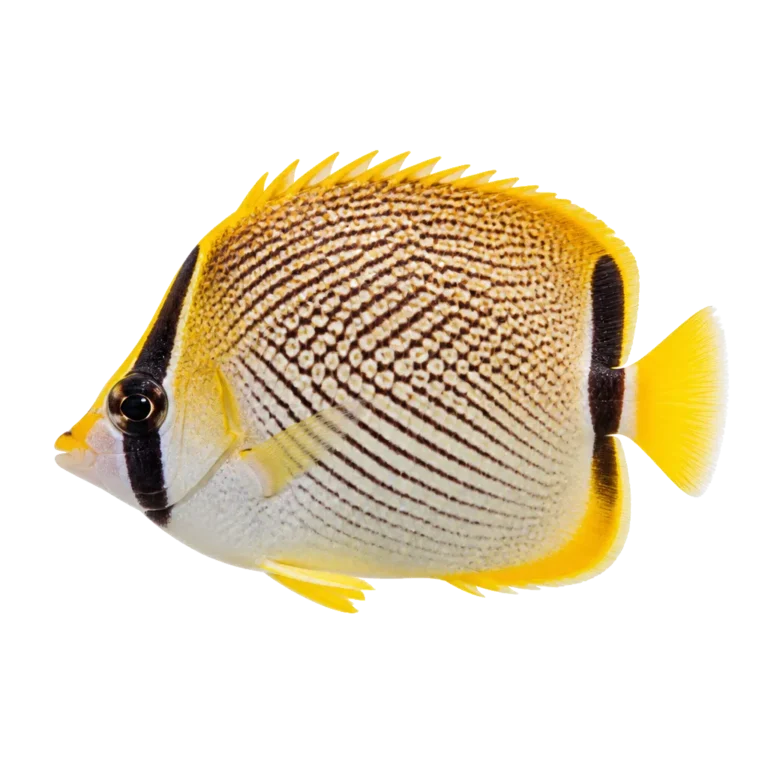
Ornate Butterflyfish
Summary
Chaetodon ornatissimus is an active, deliberate coral-picker that spends much of the day moving across reef structure and taking repeated bites from coral colonies. In an aquarium, that behaviour translates directly to persistent feeding pressure rather than occasional exploratory nipping: branching stony corals are food, not compatible décor.
Adults commonly live and forage as pairs, while smaller individuals may be encountered alone among branching coral. A fish that repeatedly patrols the same rockwork and searches every coral surface is showing normal foraging behaviour, but that behaviour is also why this species is a poor fit for a conventional reef aquarium.
Care
Use a mature, spacious fish-only system with broad, unobstructed routes around stable reef-like rockwork. Chaetodon ornatissimus is a continual cruiser and browser rather than a fish that spends its day sheltered in a cave; provide a few secure retreat areas, but prioritize long patrol routes and numerous grazing surfaces.
Do not rely on aquascape, live rock, or a mature pod population to meet its core nutritional needs. Its specialization is so narrow that a visually suitable aquarium can still fail if the fish cannot obtain and retain adequate food; persistent searching, reduced body depth, or a pinched appearance should be treated as an urgent feeding failure rather than normal acclimation.
Feeding
Do not buy Chaetodon ornatissimus unless the individual is already observed taking a meaningful amount of appropriate food and there is a realistic long-term plan for its specialized diet. This is an obligate corallivore, so prepared foods, finely chopped marine foods, and coral-based pastes may be worth trialing but must not be assumed to be nutritionally adequate simply because the fish pecks at them.
Offer small feeding opportunities repeatedly through the day and direct food onto or near a feeding surface where the fish can pick naturally. Keep rapid, forceful feeders away from its food; a butterflyfish that hangs back while other fish clear the offering may receive too little even when the aquarium appears heavily fed.
Live stony coral polyps are its natural food, particularly on branching colonies. Feeding living corals may trigger the desired feeding response, but it makes the animal unsuitable for a coral display and does not remove the difficulty of providing a sustainable, appropriate diet.
Compatibility
Keep one Chaetodon ornatissimus, or introduce only a genuinely bonded pair together. Adding an unrelated second individual after the first has settled can provoke persistent chasing and exclusion from feeding areas; do not attempt to create a pair by simply combining two specimens.
Choose calm fish-only tankmates that neither harass the butterflyfish nor win every feeding response. Avoid highly boisterous, fast-feeding species and avoid similar butterflyfishes that may compete for patrol routes and food.
Add this species before assertive community fish whenever possible, so it can establish feeding routines without having to displace entrenched, faster tankmates. It is peaceful toward many dissimilar fishes, but its reef-safety exception is absolute in practice: live stony corals, especially branching forms, are likely to be consumed.
Good to know
The main failure mode is gradual starvation after an initially encouraging start. A specimen may investigate or occasionally swallow substitute foods yet continue to lose condition over subsequent weeks; assess success by sustained body condition and confident repeated feeding, not by a single feeding response at purchase.
Do not use colour, size, or behaviour to assume sex or pair compatibility. Chaetodon ornatissimus forms stable pairs in nature, but aquarium pairing is safest only when a pair is already established; an incompatible addition may be tolerated briefly and then driven away once routine territories and feeding routes form.