
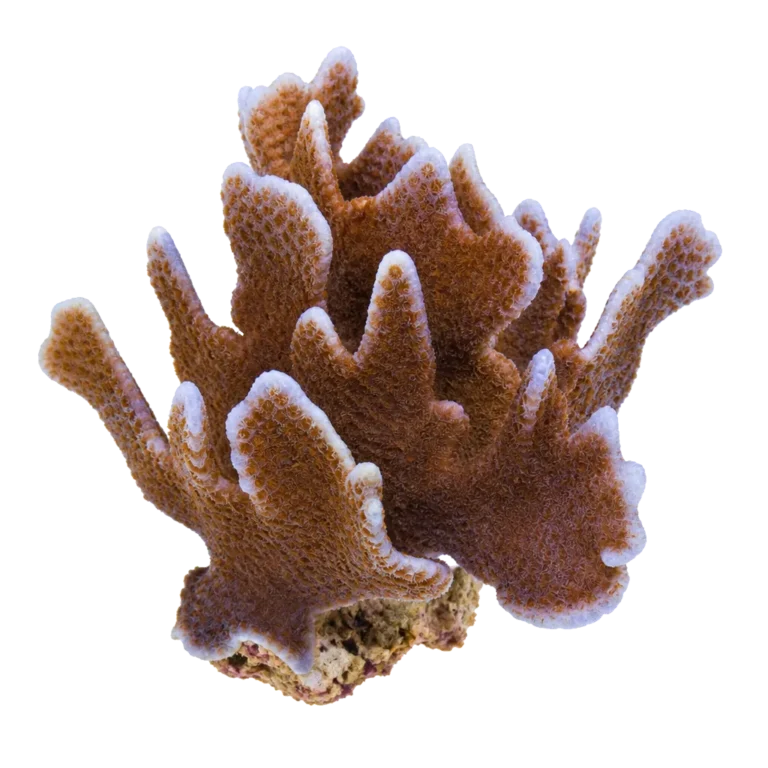
Venosa Montipora Coral
Summary
Montipora venosa is an SPS coral from the tropical Indo-Pacific that forms low, massive to encrusting colonies rather than long branches. Its surface can spread steadily across rockwork, so choose it for an open, permanent mounting area rather than a crowded mixed-coral ledge. The species is considered part of a species complex, and trade specimens may vary somewhat in colour and surface texture, but the outward, space-claiming growth habit is the practical concern.
General care
Secure this coral on upper-middle rockwork where it receives strong, indirect circulation and where every growing edge remains reachable for trimming. An isolated rock or a defined section of the aquascape is easier to manage than mounting it beside established coral bases.
Handle the plug, mounting point, or exposed skeleton rather than pressing on the living surface. Abraded tissue can become a starting point for recession or algae growth, particularly if sediment settles there. Inspect new frags closely for Montipora-eating nudibranchs and small egg clusters around the underside and plug before introduction.
Lighting needs
Introduce Montipora venosa below its final light intensity, then raise it gradually after it has resumed normal polyp extension and edge growth. Sudden placement directly under a powerful fixture can cause the upward-facing tissue to fade sharply or turn white; reduce intensity or move the frag down before tissue is lost.
Too little light usually shows as stalled encrusting, muted colour, and a thin-looking growing margin. Increase exposure gradually only after checking that detritus is not collecting on the colony and that alkalinity has been steady.
Flow needs
Provide irregular, indirect flow that keeps the colony clean without continuously pinning its small polyps flat. At the right flow, polyps can extend between pulses and the surface stays free of settled film, food, and detritus.
Too little flow leaves debris trapped in surface texture or along the base, often followed by algae and tissue loss in those areas. A direct pump blast can keep polyps withdrawn and may cause recession on the pump-facing edge; redirect the stream off rock or glass to create broader turbulence.
Feeding and growth
Photosynthesis supplies most of this coral's energy, so direct feeding is optional rather than a substitute for adequate light and stable chemistry. Broadcast very fine suspended coral foods or zooplankton-sized particles when the system is nutrient-poor, when growth has stalled despite otherwise sound conditions, or when supporting recovery after stress. Avoid coarse meaty foods that sit on the surface and foul the tissue.
Expect the colony to spread outward over rock as a low encrusting or massive form. Give it a dedicated growth path and plan to cut back the edge before it reaches other coral bases; waiting until contact occurs often means one colony has already shaded or overgrown the other.
Compatibility
Montipora venosa does not rely on long sweeper tentacles, but it competes effectively by growing over nearby sessile animals. Keep a clear boundary of at least 10 cm3.9 in around its growing edges, and increase that buffer when placing it near slow-growing SPS, zoanthids, or encrusting corals.
Most reef-safe fish and invertebrates ignore established colonies, but repeated nipping by angelfish, butterflyfish, or other coral-picking fish can leave persistent bare spots. Large snails, urchins, and burrowing animals can topple a newly mounted frag, so make the attachment secure before relying on natural encrusting to hold it in place.
Water parameters
This is moderately demanding compared with typical soft-coral or LPS husbandry because it responds poorly to swings rather than simply to an imperfect single test result. Keep alkalinity especially consistent and match any dosing changes to measured consumption; abrupt corrections can trigger paling or tissue recession even when the final reading looks acceptable.
Avoid nutrient starvation as well as sudden nutrient surges. A colony that becomes uniformly pale, stops extending at the rim, or develops recession without obvious grazing should prompt a review of recent alkalinity, salinity, temperature, lighting, and nutrient changes before making another rapid adjustment.