
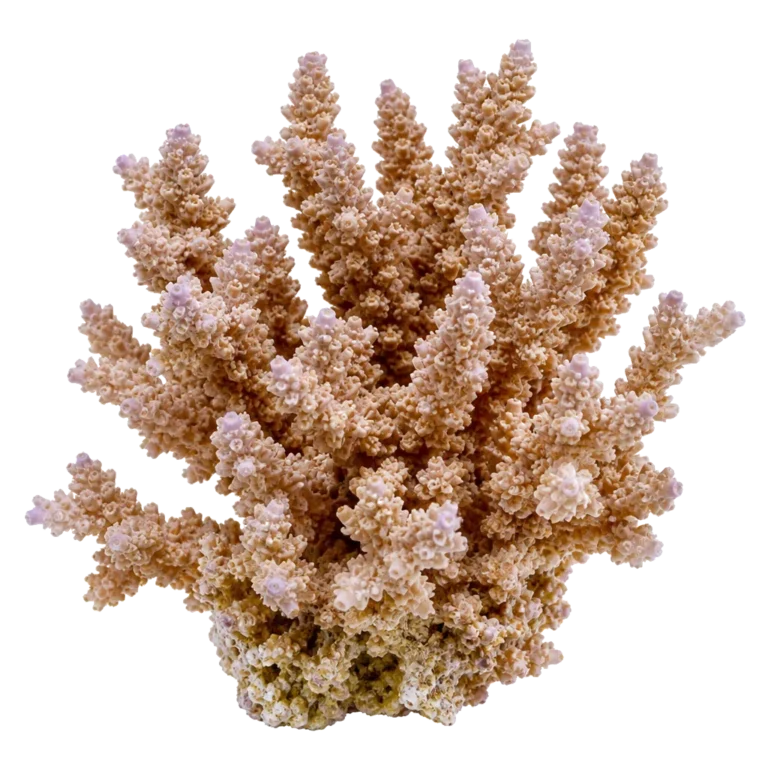
Cervera Coral
Summary
Cervera sp. is a soft, stoloniferous coral: individual polyps rise from a spreading living mat rather than from a rigid branching skeleton. That mat can quickly claim adjacent rock, so its eventual footprint matters more than the size of the frag at purchase.
Because this is a genus-level identification, colony form, colour and extension can vary between specimens. Buy it only if you can give it a defined area of removable rock and are prepared to trim or isolate new growth before it reaches other corals.
General care
Place Cervera sp. on lower-to-middle rockwork, ideally on an isolated rock or a rock with clear, accessible edges. Do not wedge it into a mixed coral garden; once the mat reaches connected rockwork, removal can require cutting away encrusted sections.
Handle the plug or attached rock rather than pinching the mat or pulling on extended polyps. Freshly cut or damaged areas may remain closed for a time, but persistent recession, exposed bare patches or a loose, deteriorating mat indicate irritation, unsuitable flow or declining water quality.
Lighting needs
Begin a new colony in the lower part of its intended placement and increase exposure gradually over several weeks. This gives the photosynthetic symbionts time to adjust without forcing the colony to stay tightly contracted.
At suitable light, polyps should open predictably and the mat should retain an even, healthy appearance. Persistently weak extension and a fading or thinning colony can indicate insufficient usable light, while prolonged closure, paling and retraction after a lighting increase suggest excessive exposure; move it lower or provide partial shade rather than making another abrupt change.
Flow needs
Provide moderate, indirect, variable flow that keeps the polyps gently moving and clears debris without pinning them against the mat. Aim the return or powerhead past the colony rather than directly at it.
Too little flow allows detritus and film algae to settle between polyps, often followed by reduced extension and dirty-looking tissue. Too much flow causes polyps to remain bent over or closed, and may lift or fray the edge of a recently attached mat.
Feeding and growth
Cervera sp. receives most of its energy from light, so feeding is optional rather than a substitute for correct placement. Fine suspended planktonic foods or finely powdered particulate foods can help support a newly established colony or one maintained in a very lean system; broadcast feed lightly and avoid blasting food directly into the polyps.
Expect it to grow as an expanding mat with new polyps appearing beyond the original frag. Growth can be fast when conditions suit it, so leave open rock around the colony and remove or trade back advancing edges before they contact other sessile animals.
Compatibility
Its main aggression is physical encroachment: the spreading mat can overgrow slower corals even though it does not rely on powerful sweeper tentacles. Keep at least 10 cm3.9 in of clear rock between it and neighbouring corals, and allow more room where the colony can spread along a continuous surface.
Avoid placing it beside corals that cannot be moved or trimmed around, especially slow-growing encrusters and small-polyped stony corals. Fish or invertebrates that repeatedly pick at soft-coral polyps can keep a new frag closed, while large grazing or digging animals may dislodge it before the mat has secured itself.
Water parameters
This is generally less demanding than many stony corals, but it responds poorly to abrupt changes rather than to modest day-to-day variation within a well-run reef system. Sudden shifts can cause the entire colony to close and may leave damaged mat edges vulnerable to algae.
Prioritize consistent salinity and alkalinity, particularly after water changes or dosing adjustments. If the colony remains closed for several days, inspect first for a recent parameter swing, detritus trapped in the mat, excessive flow or an advancing neighbour rather than immediately increasing light or food.