
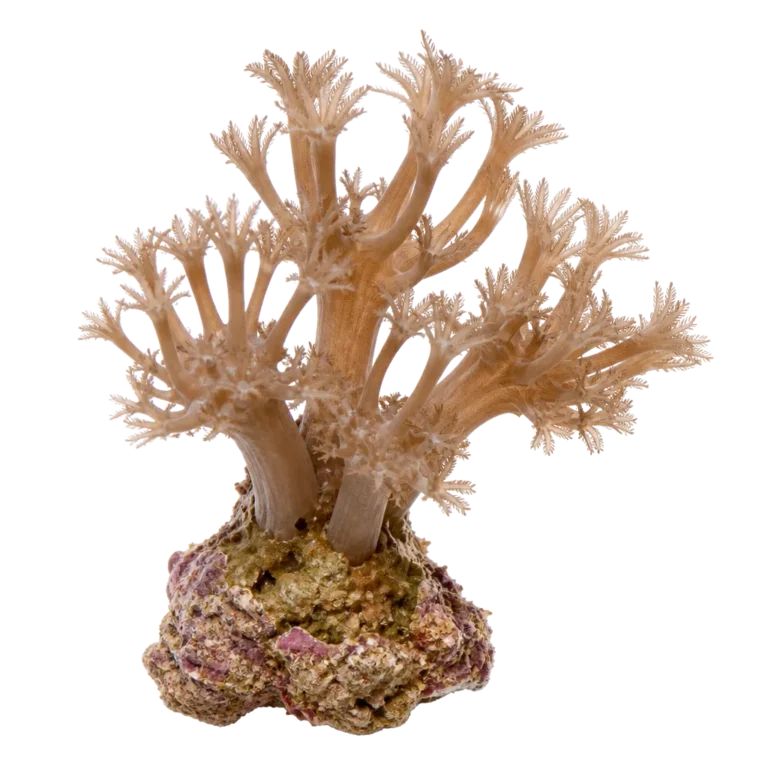
Tree Polyp
Summary
Acrozoanthus australiae is a zoanthid often sold as a Tree Polyp or Stick Polyp. Its upright “stick” is typically a eunicid worm tube covered by connected polyps, rather than a branching soft-coral skeleton. Keep that structure upright and securely supported; a loose or toppled tube leaves the colony unable to present its polyps properly to light and current.
In nature, this species occurs on the outsides of worm tubes in shallow, moving reef environments. That association explains its vertical growth habit and why it should be treated as a tube-based colony rather than a mat zoanthid that can simply be laid on sand or wedged under rockwork.
General care
Mount the colony in the middle of the aquascape on stable rock, with the tube held upright and clear of sand. Do not bury the base or allow loose rock to knock against it; trapped sediment and repeated abrasion can keep individual polyps closed and cause tissue to recede from the tube.
Handle the rock, plug, or tube rather than the polyp heads. Avoid crushing, cutting, or pulling apart the tube, especially if it appears occupied by its associated worm. Select specimens with firm attachment, intact tissue between polyps, and polyps that open after settling; a colony with detached tissue or persistently floating polyps is a higher-risk purchase.
Lighting needs
Begin a new Acrozoanthus australiae colony under subdued exposure within its intended area, then increase exposure gradually over several weeks. This reduces the chance of abrupt contraction or bleaching while its photosynthetic symbionts adjust to the aquarium’s spectrum and intensity.
Underexposure usually shows as weak extension, darker-looking polyps, and little new budding. Too much light is more often signaled by unusually tight closure during the photoperiod, faded oral discs, or pale tissue; move the colony into gentler exposure rather than making a large lighting change all at once.
Flow needs
Provide indirect, variable flow that gently moves the tentacles and keeps the tube free of settled debris without folding the polyps over. Correct flow produces open polyps with relaxed tentacles that remain extended rather than being held rigidly in one direction.
If flow is too low, detritus can collect around the tube and polyps may open poorly or develop a persistent film. If flow is too forceful or direct, the colony stays partly retracted, the tentacles stream hard in one direction, and exposed tissue may become irritated; redirect the outlet rather than simply increasing or decreasing all circulation.
Feeding and growth
Photosynthesis supplies most of this coral’s routine energy, but occasional feeding is useful for recently imported colonies, nutrient-lean systems, and colonies being grown or propagated. Offer fine zooplankton-sized foods or very small meaty particles when the polyps are open, and avoid large chunks that sit on the oral discs or foul the surrounding tissue.
Growth usually appears as additional polyps and connected tissue spreading along the tube, with established colonies sometimes extending onto adjoining hard surfaces. Give the colony room not only for the present tube but also for the direction in which its base can spread; otherwise it can gradually claim a neighboring frag plug or rock.
Compatibility
Acrozoanthus australiae competes by close-contact stinging and by growing over available surfaces, rather than by remaining confined to its original tube. Leave at least 10 cm3.9 in between it and slow-growing corals or sessile invertebrates, and place it where its spread can be watched and trimmed or isolated before it reaches them.
Avoid placement beside corals that cannot tolerate contact, especially encrusting species with little ability to escape. Fish that repeatedly nip zoanthid polyps can prevent normal opening, while crabs or other mobile invertebrates that climb through the colony may dislodge the tube; repeated closure after these visits is a practical reason to move or secure the colony. If a worm inhabits the tube, allow clearance around its opening for normal nighttime emergence rather than treating the tube as inert decoration.
Water parameters
This is generally less demanding than many delicate stony corals once it has attached and opened consistently, but it responds poorly to abrupt changes. Rapid shifts in salinity, alkalinity, or temperature commonly appear first as multiple days of closed polyps, loss of inflation, or tissue pulling away from the tube.
Do not mistake a brief closure after handling or feeding for a water-quality crisis. Investigate conditions when closure persists across several normal light cycles, particularly if it is accompanied by paling, mucus, or basal recession. Because the species relies heavily on photosynthetic symbionts, excessively stripped nutrients can also coincide with pale color and stalled growth.