
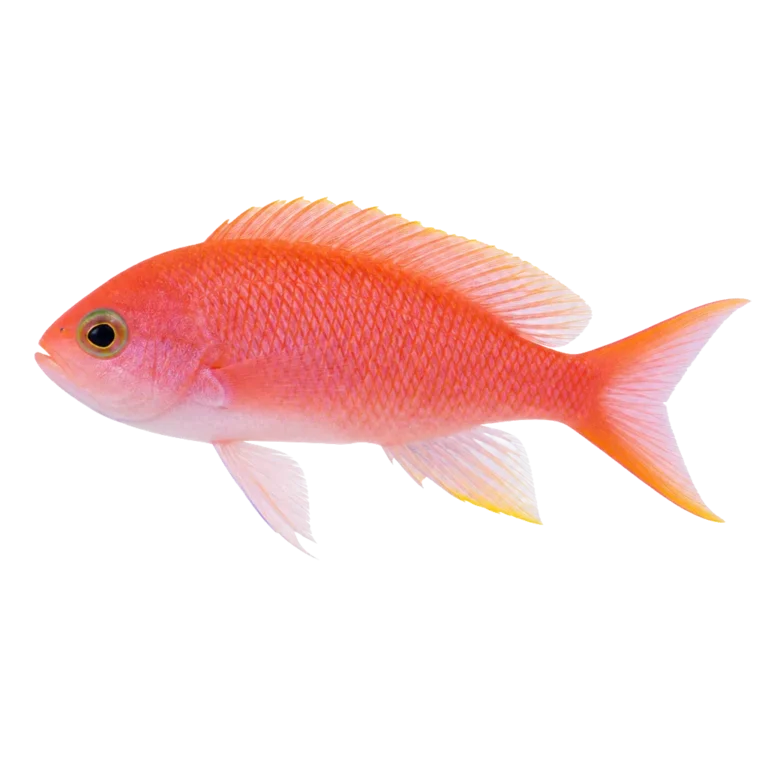
Cherry Anthias
Summary
Sacura margaritacea is an active, mid-water anthias that spends much of the day picking small prey from the water column rather than grazing rockwork. In an aquarium, it should be visible in open water once settled, but it needs nearby rock cover to retreat to when startled or when a dominant fish is passing.
Its natural tendency to occur in schools does not make any random collection of Cherry Anthias peaceful. Social rank matters: a male can claim the main swimming area and repeatedly pressure females, juveniles, or similar-looking anthias. Plan the social group before purchase rather than adding individuals gradually.
Care
Build the aquascape with a broad, unobstructed swimming lane in front of rockwork, plus caves, ledges, and broken lines of sight behind it. A Cherry Anthias that remains wedged in a crevice after its settling period is often being intimidated, struggling with overly forceful tankmates, or unable to find a low-conflict route through the aquascape.
Use brisk, oxygen-rich water movement that keeps fine foods circulating through the water column, while retaining calmer pockets behind the rockwork. Constantly fighting a direct pump outlet can leave the fish hovering low or sheltering all day; conversely, a stagnant layout makes it harder to maintain its normal active feeding pattern.
Treat the cooler end of its listed temperature preference as meaningful when choosing tankmates. Avoid combining it with livestock that demands unusually warm conditions, since keeping Sacura margaritacea chronically warmer than its preferred range can increase metabolic demand at the same time as it needs frequent feeding.
Feeding
Offer several small meals spread through the day instead of one large feeding. Use varied, finely sized marine foods such as copepods, mysis, enriched brine shrimp, and finely chopped seafood; present them into the current so the fish can feed in the water column.
Watch each individual during feeding, especially in a group. A subordinate fish may rush out for the first few particles, then retreat as the dominant fish takes the central feeding lane. Add food from more than one point or feed in successive small portions until every fish is making repeated feeding strikes.
Do not rely on brine shrimp alone. It can be useful for tempting a new arrival to eat, but a narrow diet can leave an otherwise active anthias gradually losing body condition. A pinched abdomen, reduced interest in food, or spending most of the day in cover calls for more frequent access to varied, energy-rich foods and an assessment of feeding competition.
Compatibility
Keep a single Cherry Anthias, or establish a planned social group of one male with several females or juveniles introduced together. Avoid adding a new individual to an established male’s territory unless the system has substantial extra space and multiple escape routes; the newcomer may be chased continuously rather than accepted into the group.
Do not keep more than one mature male in an ordinary home reef aquarium. Males can be territorial toward conspecifics and other anthias, and prolonged chasing tends to concentrate on the lowest-ranking fish until it stops feeding or remains hidden.
Choose peaceful-to-moderately assertive tankmates that leave the mid-water feeding zone usable. Large predatory fishes, persistent chasers, and faster fish that monopolize every feeding event are poor companions. Introduce the Cherry Anthias before strongly territorial fish so it can learn the rockwork and establish a feeding routine.
It is generally suitable for coral reefs, but very small ornamental shrimp or similarly sized mobile crustaceans are a sensible exception to treat cautiously. Its prey response is directed at small animals moving in the water column.
Good to know
Sacura margaritacea is protogynous: females can transition to male as social conditions change. In an all-female or juvenile group, the largest or most dominant individual may become male, after which its color, posture, and territorial behavior can become more pronounced. Do not assume a previously calm group will retain the same hierarchy indefinitely.
A newly dominant fish that repeatedly drives another anthias into cover is not simply displaying normal activity if the target is missing meals. Intervene early by separating the aggressor or subordinate fish; waiting for the victim to become visibly thin often makes recovery more difficult.
New arrivals can be slow to settle after collection and shipping. Give them immediate access to sheltered rockwork and offer small foods repeatedly in the first days. A fish that only emerges briefly at feeding time may be acclimating, but one that refuses food and remains withdrawn needs prompt attention rather than being left to compete in a busy community tank.