
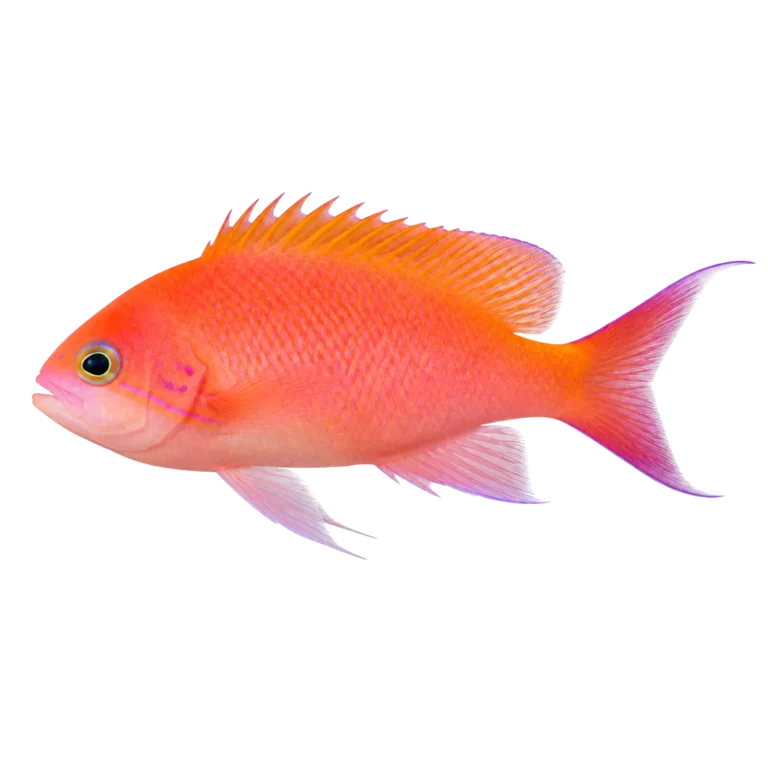
Noble Anthias
Summary
Pseudanthias nobilis is an open-water planktivore that should spend much of the day hovering and making short, quick dashes into the current for suspended food. A new fish may initially stay close to rockwork, but a settled individual that remains hidden or hangs back at every feeding is often being intimidated, underfed, or still poorly acclimated.
Its social behaviour is based on rank rather than a loose, equal school. A dominant fish may patrol a preferred area and repeatedly drive weaker conspecifics away; in an aquarium, the fish receiving that attention can become reclusive and lose condition before obvious injury appears.
Care
Build the aquascape with a broad, unobstructed water column in front of or above the reef structure, plus branching rockwork and overhangs that allow a startled fish to retreat without becoming trapped. This species is not a bottom-perching fish; filling every open swimming lane with rock can leave it pacing the glass or confined to a small corner.
Provide brisk, oxygen-rich circulation that carries fine food through the midwater rather than a single harsh jet aimed at its resting area. The desired behaviour is repeated hovering into the flow and brief feeding sorties; persistent sheltering in low-flow corners can indicate that the current pattern or tankmate pressure is unsuitable.
Plan filtration and nutrient export around the feeding routine before adding this species. The practical challenge is not simply offering food, but sustaining repeated feedings without allowing accumulated waste to undermine the reef system.
Feeding
Offer varied, appropriately small zooplankton-style foods in several daylight feedings: copepods, finely sized mysis, enriched brine shrimp, and other small marine meaty preparations. Release food into the current so it remains suspended long enough for the fish to intercept it naturally rather than dropping immediately to the substrate.
Feed in a way that lets every individual make repeated passes at food. Fast, boisterous planktivores and larger fish can clear the water column before a Noble Anthias has fed adequately; use more than one delivery point or briefly target-feed the anthias side of the aquarium when competition is evident.
Do not rely on a single large meal. The key warning sign is a fish that still comes out at feeding time but develops a pinched body behind the head or a hollow-looking back, which points to chronic calorie shortfall rather than simple shyness.
Compatibility
A single Pseudanthias nobilis is the lower-risk choice when the aquarium cannot support a carefully managed social group. If keeping multiples, introduce a group together, use only one established male, and give subordinate fish ample open water and separate retreat routes; adding a lone newcomer to an established male is the arrangement most likely to produce sustained chasing.
Favour peaceful reef fish that occupy different zones or feed without monopolising the water column. Avoid assertive dottybacks, hawkfish, large damsels, and other persistent pursuers, particularly during introduction, because an anthias that is repeatedly forced into cover may stop taking enough food.
It is compatible with reef invertebrates in the usual sense that it does not target corals or ornamental crustaceans. The reef-specific trade-off is its feeding demand: stock it only where the system can absorb frequent planktonic foods without compromising coral husbandry.
Add Noble Anthias before territorial fish with similar midwater habits, or rearrange territory before introduction if such fish are already established. This reduces the chance that the anthias is confined to the edge of the aquascape from its first day.
Good to know
Watch social groups closely after the initial settling period, not just on the day they are introduced. Hierarchy problems often show as one fish eating last, spending more time behind rock, or showing a progressively thinner body while the dominant fish appears normal.
Pseudanthias are protogynous: the dominant female can transition to male when the social structure changes. Do not interpret a changing colour pattern or increasingly territorial display as automatically a disease problem; assess whether it coincides with the loss or removal of a male and whether subordinate fish are still feeding normally.
Use a secure cover. Anthias can launch from the aquarium when startled by abrupt lighting changes, netting, or aggression, so an otherwise healthy fish may be lost during the first weeks if openings around cables or plumbing remain uncovered.