
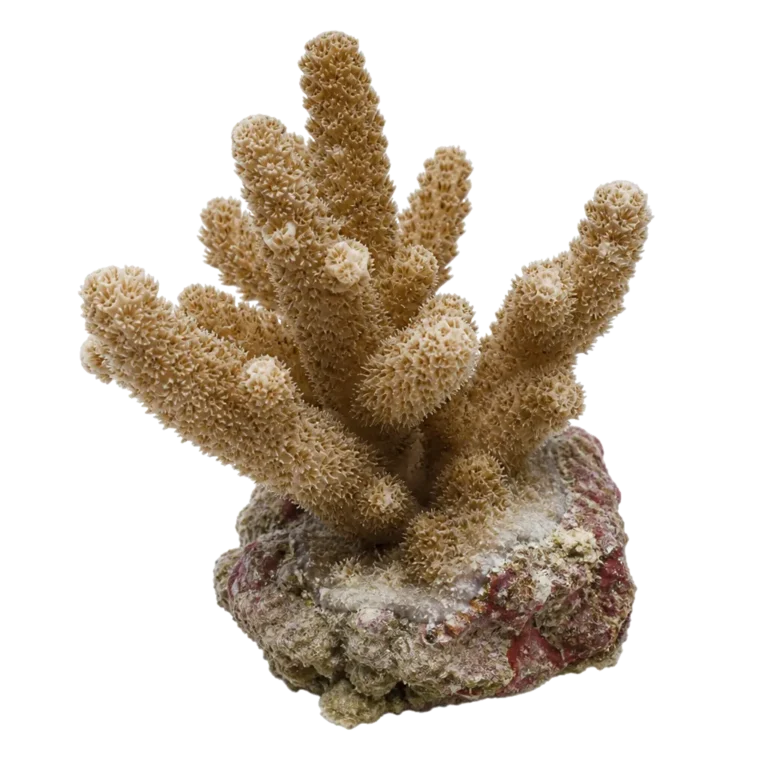
Branching Psammocora Coral
Summary
Psammocora stellata is a small-polyp stony coral with a finely pitted surface and a variable shape: it commonly grows from an encrusting base into short, irregular branches or knobby lobes. Its occurrence on shallow, wave-washed reef rock explains why it performs best when water movement is active and changes direction rather than remaining still. Plan for its shape to change with placement; a small frag can gradually occupy both the rock beneath it and the open space above it.
General care
Mount this coral securely on stable rock in the middle of the aquascape, where it can receive moderate light and indirect, turbulent flow. Avoid placing it where sand can settle into its small surface depressions or where a wavemaker delivers a constant, narrow jet. Its tissue is thin over a hard skeleton, so handle the plug or bare skeleton rather than rubbing, squeezing, or resting fingers on the living surface. Freshly cut or damaged edges should be protected from sediment and strong direct flow, as exposed areas can recede instead of healing.
Lighting needs
Begin a new Psammocora stellata lower in its intended light zone or reduce intensity at first, then increase exposure gradually after it remains normally colored and shows stable tissue coverage. Too much light commonly shows as paling or bleaching on the most exposed branch tips and upper surfaces, sometimes followed by tissue recession. Too little light is more likely to produce a darker, browner appearance with limited new encrusting growth; correct either problem slowly rather than moving the coral abruptly from one extreme to another.
Flow needs
Aim for irregular, moderate flow that keeps the coral’s fine polyps gently active and leaves the pitted surface free of settled detritus. Insufficient flow is indicated by debris collecting in the surface depressions, reduced polyp extension, or tissue loss beginning where sediment remains trapped. Excessive direct flow can keep polyps tightly retracted and cause recession on the side facing the pump, so redirect the source rather than simply reducing all circulation.
Feeding and growth
Light provides most of this coral’s energy, but occasional feeding is useful in nutrient-lean systems, during recovery, or when the goal is to support growth. Offer fine suspended planktonic foods or very small particulate coral foods when feeding tentacles are visible; large meaty pieces are poorly suited to its tiny polyps and can settle on the colony. Growth usually begins as an encrusting margin and develops into uneven short branches or lobes, so leave open rock around the base as well as vertical room above it.
Compatibility
Psammocora stellata is generally peaceful, but it can still damage or be damaged by corals that make direct contact as its encrusting edge expands. Leave at least 5 cm2 in of clear space around a new frag and more where its branches can grow toward neighbors; do not rely on a narrow gap remaining open once it starts to spread. Keep it away from coral-nipping fish and invertebrates that repeatedly pick at SPS tissue, and secure the frag against burrowing or rock-moving animals that can topple it into another coral.
Water parameters
This is less forgiving of abrupt chemistry changes than many soft corals and should be added only to a reef with established, consistent alkalinity, salinity, and temperature. Sudden alkalinity shifts are especially likely to show first as tip recession, patchy tissue loss, or a rapid loss of normal color. Avoid aggressive nutrient stripping as well: a colony that progressively pales despite appropriate lighting may be receiving too little available nutrition rather than too much light.