
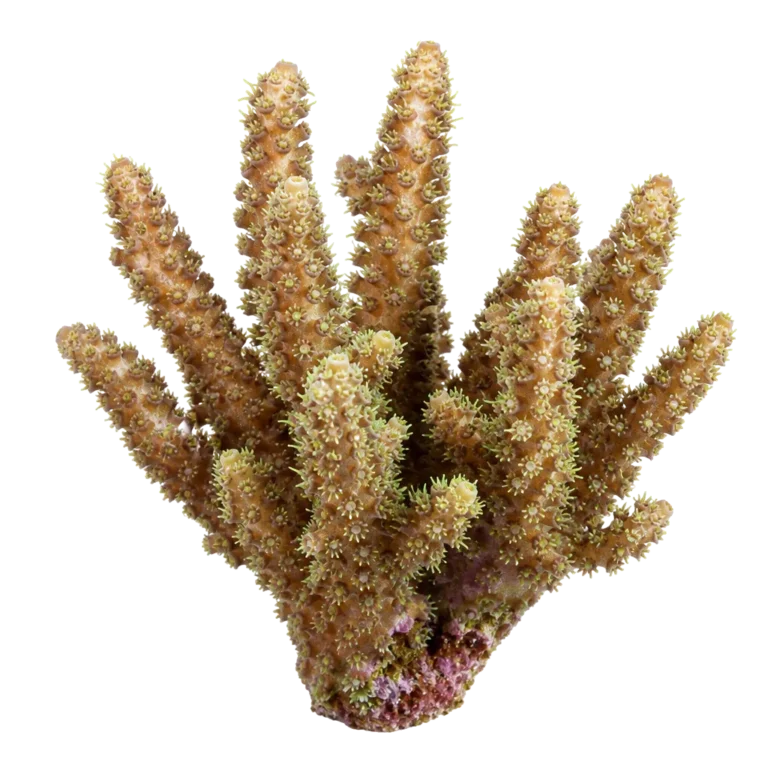
Branching Galaxea
Summary
Galaxea horrescens is a branching LPS coral with thin, tubular branches and star-like polyps. Its open, arborescent form is easy to damage and gives it far more reach than a compact frag suggests. In nature it occurs in illuminated reef areas with moving water, which translates to a middle placement with broad, indirect circulation rather than a sheltered corner.
Treat its long defensive sweeper tentacles as the defining stocking issue. They are often most apparent after dark and can sting corals well beyond the visible daytime polyp canopy.
General care
Mount Galaxea horrescens securely where its branches will not be bumped by cleaning tools, rockwork, or passing fish. Place flow across the colony rather than directly into one side, and leave open water around it instead of fitting it into a densely packed coral garden.
Handle the plug or solid base, never the branch tips or living tissue. The branching skeleton is comparatively fragile, so a fall or pressure on a branch can cause breakage; inspect new frags for cracked branches and damaged tissue before purchase.
Lighting needs
Start a new specimen in a slightly shaded position or under a reduced lighting schedule, then increase exposure gradually after it resumes normal daytime extension. This avoids asking a recently shipped coral to adapt to new spectrum and intensity at the same time.
At suitable light, polyps remain extended and colour is maintained without persistent paling. Bleaching, a washed-out appearance, or repeated daytime retraction after a lighting increase calls for moving it lower or off-axis from the fixture. In insufficient light, growth commonly slows and the colony may darken while maintaining less robust extension; correct this by making small upward moves rather than making a sudden large increase.
Flow needs
Provide varied, indirect medium flow that keeps the fine tentacles in continual, loose motion and carries away mucus and settled particles. The ideal response is an inflated colony with polyps able to extend naturally, not tentacles pinned in one direction.
If detritus accumulates between branches, tissue stays coated, or the colony looks stagnant, increase random circulation. If a pump causes one side to remain tightly withdrawn, exposes tissue around the corallites, or makes the polyps whip sharply, diffuse or redirect the flow instead of simply increasing it further.
Feeding and growth
Lighting supplies most of this coral's energy, so target feeding is optional rather than a requirement for routine survival. Occasional feeding is most useful for a small new frag, a colony being encouraged to grow, or a system with very little suspended food. Offer fine zooplankton-sized foods or finely minced meaty foods when feeding tentacles are visible, and avoid oversized pieces that sit on the tissue or foul the branches.
Galaxea horrescens grows as an irregular branching colony, expanding outward as well as upward. Plan the final location as an isolated patch rather than a gap between established corals, because both the living branches and their nighttime sweepers claim progressively more space.
Compatibility
Galaxea horrescens is aggressive because it deploys long sweeper tentacles that sting neighbouring corals on contact, often after lights-out. Reserve at least 30 cm11.8 in of open clearance in every direction, and check the colony after dark before deciding that a nearby coral is safely placed.
Do not rely on a neighbour's toughness: even other LPS corals can suffer repeated tissue damage from nightly contact. Fish that routinely nip fleshy corals can keep polyps retracted, while coral-eating angelfish, butterflyfish, and filefish are a poor match. Mobile invertebrates that repeatedly climb through the branches can also irritate or break this delicate colony.
Water parameters
This is moderately demanding rather than unusually delicate when a reef system is mature and consistent. Keep alkalinity, salinity, and temperature changes gradual; abrupt shifts can be followed by prolonged retraction, loss of extension, or tissue recession along the sharp branch structure.
Avoid allowing detritus to remain trapped in the branching skeleton, especially after a change in circulation or a nutrient-management adjustment. A colony that stays contracted while water tests appear acceptable should be checked for nighttime stings, localized flow problems, and debris accumulation before assuming it needs more light or food.